Pablo Picasso
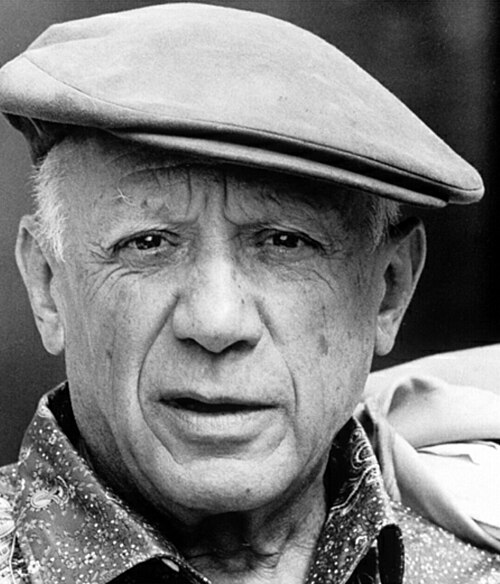
Quick Facts
Introduction
Pablo Ruiz y Picasso (October 25, 1881 – April 8, 1973) was a Spanish painter, sculptor, printmaker, ceramicist, and stage designer whose experimental work broke five centuries of Renaissance one-point perspective. Co-founding Cubism alongside Georges Braque, Picasso exemplified lifelong prolific iteration: over an astonishing ~78-year working life, he produced an estimated 50,000 artworks—roughly 1,885 paintings, 1,228 sculptures, 2,880 ceramics, and tens of thousands of drawings and prints—demonstrating that even prodigies sustain breakthroughs only through nonstop stylistic reinvention.
Early Life
Born on October 25, 1881, in Málaga, Andalusia, Spain, to Basque drawing professor José Ruiz y Blasco and María Picasso y López, Pablo allegedly uttered "piz, piz" (short for lápiz, pencil) before forming full sentences and demonstrated extraordinary classical drafting mastery by age twelve.
Education
Trained first by his father, Picasso entered Barcelona's School of Fine Arts (La Llotja) at thirteen (completing a month-long adult entrance exam in a single day) and studied briefly at Spain's premier Real Academia de Bellas Artes de San Fernando in Madrid (1897–1898)—rapidly abandoning stuffy academic copying to devour El Greco, Diego Velázquez, Cézanne, and African/Iberian masks across Madrid and Paris museums.
Career & Contributions
Refusing to settle comfortably into any single marketable style—even after winning rapturous praise during his Blue Period (1901–1904) and Rose Period (1904–1906)—Picasso continually destabilized his own mastery:
- Co-Founding Cubism (1907–1914, with Georges Braque): Triggered by his confrontational 1907 canvas Les Demoiselles d'Avignon (fusing Cézanne's geometric planes with African mask forms) and tight daily studio rivalry with Braque ("roped together like mountaineers"), fractured three-dimensional subjects across simultaneous viewpoints (Analytic Cubism) and glued newspaper/oilcloth scraps onto canvases (Synthetic Cubism / Collage).
- Prolific Variation & Masterpiece Output (Guernica, 1937): Creating his anti-war mural Guernica across 45+ meticulous dated sketches and photographic stages, revising violently on canvas rather than guarding fragile initial sketches (equal-odds output discipline).
- Biographical & Ethical Nuance: Modern art historians examine Picasso with clear-eyed honesty—separating his formal visual innovations from his well-documented cruel, manipulative treatment of intimate partners and muses (Fernande Olivier, Olga Khokhlova, Marie-Thérèse Walter, Dora Maar, Françoise Gilot), whose psychological cost shaped decades of his late portraiture.
Collaborations & Intellectual Exchanges
Georges Braque
Between 1907 and 1914, Braque and Picasso met almost daily in Paris, discarding individual signatures on canvases at moments as they co-invented Analytic and Synthetic Cubism.
Dean Keith Simonton
Simonton traced Picasso's 45 dated Guernica sketches and ~50,000 lifelong works as prime empirical proof that bold masterpieces emerge through high-volume blind-variation experiments rather than effortless lightning.
Ted Orland
Orland and Bayles cite Picasso's fearless volume of abandoned experiments in Art & Fear as the antidote to novice fear of ruining a single blank canvas.
Major Achievements & Honors
- Co-founded Cubism, invented modern collage and constructed sculpture, and reshaped global painting, sculpture, and ceramics.
- Produced roughly 50,000+ documented artworks across nearly eight decades, anchored by icons Les Demoiselles d'Avignon (1907) and Guernica (1937).
- Awarded the International Lenin Peace Prize (1950, 1962) and commemorated in major dedicated national museums in Barcelona, Paris, and Málaga.
Legacy & Historical Impact
Painting relentlessly into his ninety-second year right up until the night before he died, Pablo Picasso passed away of pulmonary edema and heart failure on April 8, 1973, in Mougins, France, at age 91 (interred at the Château of Vauvenargues).
Separating honest moral critique of his personal cruelty from his technical achievement, Picasso left one unforgettable creative principle proven across fifty thousand drafts: mastery requires first acquiring the rules like a pro, then tearing them apart daily like an artist.


