Best Books for Deep Work and Concentration
Most people try to focus the wrong way. You sit at your desk and open a blank document. You put your phone right next to your keyboard. You tell yourself you'll work for three hours straight. Then a notification pings. You check it. It only takes five seconds, but your focus is gone. You spend the rest of the day bouncing between tabs, feeling busy but achieving nothing.
Science Petal Research Group
Empirical Curation on Human Cognitive Mechanics
The Best Books for Focus at a Glance
- • Best overall: Deep Work — A strict training manual to conquer distractions and build focus stamina.
- • Best for habits: Atomic Habits — Automates concentration by designing a distraction-free workspace.
- • Best for systems: Stolen Focus — Uncovers how tech apps are engineered to split your focus.
- • Best for load: The Organized Mind — Frees up brain power by externalizing mental clutter.
- • Best for energy: Head Strong — Optimizes sleep, food, and light biology to cure brain fog.
The Myth of Multitasking
Why is it so hard to sit still and focus? Because we confuse being active with being productive. When you check your email while writing a document, you feel fast. Your brain gets a tiny dopamine hit from every new ping. You trick yourself into thinking you are getting things done.
You are not. Your brain cannot process two complex tasks at once. It just switches back and forth incredibly fast. Every time you switch, a little bit of your attention gets left behind on the last task. This drag is called attention residue. If you check your phone every ten minutes, your mind is always fragmented, never reaching the deep focus required to solve hard problems.
According to landmark cognitive research by Dr. Sophie Leroy (2009), when people switch from an unfinished Task A to a new Task B, their brain does not switch cleanly. A portion of their attention remains stuck on Task A. This cognitive drag leaves you with less working memory and significantly lowers your performance on the new task.
To fix this, you need to understand the biological and environmental mechanics of attention. These seven books provide the exact roadmap to rebuild your focus from the ground up.
The 7 Books to Master Concentration
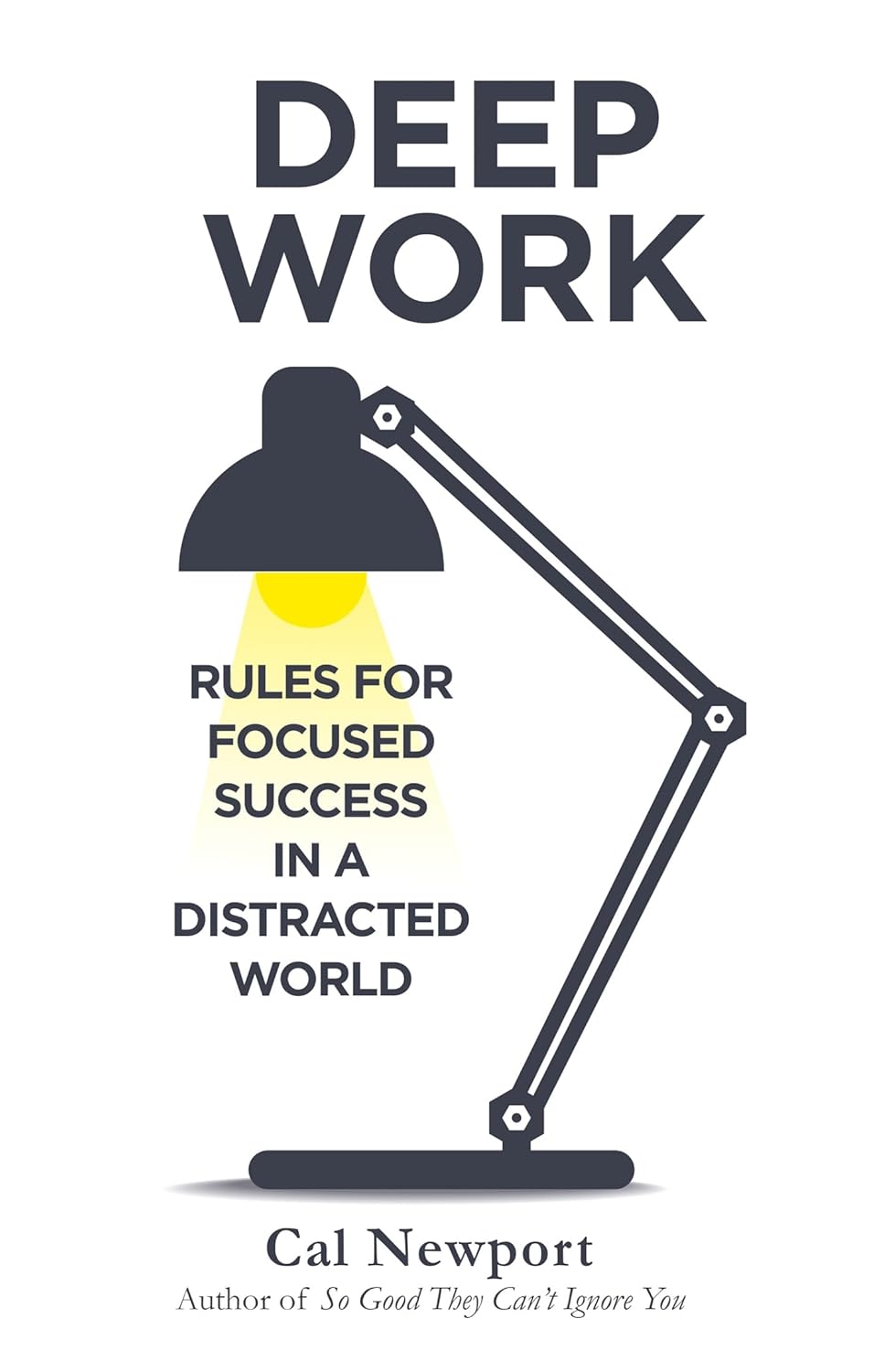
Deep Work
Cal Newport
Why This Book
You cannot do meaningful work when your attention is split. Checking your phone or email every ten minutes leaves you in a state of constant mental fragmentation. Cal Newport treats focus as a physical skill you must build. He shows why long, uninterrupted blocks of focus are the only way to master complex skills and produce high-value results.
Key Idea & Takeaway
Stop waiting for the perfect quiet moment to work. Instead, design a strict execution routine. Newport offers four rules to isolate your mind from digital noise. By time-boxing your day and learning to tolerate boredom without reaching for your phone, you train your brain to go deeper for longer.
Editorial Opinion
We rank this as the absolute starting point for anyone struggling with focus. Most productivity advice assumes you can already sit still. Newport actually gives you the daily protocol to train your mind to ignore distraction.
Primary Target: Cognitive Stamina
Impact Speed: Immediate
Best For: Knowledge Workers
Developers, researchers, writers, and students seeking a rigorous, step-by-step program to structure their days around long-term intellectual outputs.
Professionals in customer-facing roles or emergency dispatch whose core value depends on constant, real-time routing and immediate response.

Stolen Focus
Johann Hari
Why This Book
If you think your short attention span is just a personal failure, you are wrong. Johann Hari uncovers how modern tech platforms are designed to actively steal your focus. By understanding the systemic and environmental forces fighting against you, you can stop blaming yourself and start fighting back.
Key Idea & Takeaway
Social media apps use the same psychological triggers as slot machines. They keep you scrolling by offering unpredictable rewards and outrage. Reclaiming your focus requires changing your environment, limiting screen time, and protecting your sleep, rather than relying on sheer willpower.
Editorial Opinion
This is an eye-opening look at the modern attention crisis. Hari doesn't just offer self-help tips; he explains the bigger picture, helping you realize why focus feels so difficult today.
Primary Target: Attention Protection
Impact Speed: 1 Week
Best For: Digital Addicts
Readers who find themselves helplessly trapped in infinite scrolling, seeking to understand the systemic forces that govern digital addiction.
Readers looking purely for technical individual productivity software hacks or calendar optimization steps; this is a broad sociological critique.

The Organized Mind
Daniel J. Levitin
Why This Book
Your brain has a limited capacity for holding information. Trying to remember every task, email, and meeting drains your energy. Neuroscientist Daniel Levitin explains how to clear this mental clutter by externalizing your memory. This frees up your brain's processing power for deep focus.
Key Idea & Takeaway
The brain's attentional filter consumes glucose with every single decision you make, big or small. Choosing what to wear or what email to answer burns the same fuel as solving a complex problem. By writing things down, using physical organizers, and making fewer daily choices, you save your brain's energy for raw concentration.
Editorial Opinion
A highly practical manual on how to structure your physical and digital life. Levitin uses neuroscience to show why a messy mind is a distracted mind, and gives you the exact blueprint to fix it.
Primary Target: Cognitive Load
Impact Speed: 3 Days
Best For: Overloaded Professionals
Executives, team leaders, and administrators who manage massive inputs of daily logistics and seek scientific methods to clean up information clutter.
Readers who want light, quick, inspirational productivity checklists. Levitin is a neuroscientist, and his work contains detailed explanations of brain anatomy and function.

Atomic Habits
James Clear
Why This Book
You don't rise to the level of your goals; you fall to the level of your systems. James Clear explains why daily focus is the result of small, automated habits. By removing the friction of starting, you make deep work an effortless default rather than a daily struggle.
Key Idea & Takeaway
Habits run on a simple loop: cue, craving, response, and reward. To focus better, make the cues of focus highly visible (like setting up your desk the night before) and make the cues of distraction invisible (like putting your phone in another room).
Editorial Opinion
This is the best guide ever written on building daily consistency. Clear translates complex human behavior into simple, actionable steps that anyone can start using today.
Primary Target: Consistent Habits
Impact Speed: 2 Weeks
Best For: Procrastinators
Anyone struggling with daily consistency, looking for a clear, actionable guide to restructure their daily environment and habits from scratch.
Readers who have already established highly consistent, automated habits and are looking for highly specialized, professional workflows.

Why This Book
Focus is a physical process that requires raw biological energy. If your brain is tired, inflamed, or starved of proper fuel, no time-management system will save you. Dave Asprey shows how to optimize your diet, sleep, and light environment to give your brain the energy it needs to concentrate.
Key Idea & Takeaway
Your prefrontal cortex has the highest density of mitochondria—your cells' energy engines—in your body. By reducing sugar, avoiding late-night blue light, and taking short cold showers, you increase your cellular energy output, naturally clearing brain fog.
Editorial Opinion
An excellent guide for high performers who want to fix the physical side of focus. Asprey reminds us that your brain is an organ, and you have to feed it right if you want it to work.
Primary Target: Cellular Energy
Impact Speed: 2 Weeks
Best For: High Achievers
Readers interested in biohacking, biological performance, and using physical interventions (sleep, light, food) to boost raw mental processing power.
Traditionalists seeking standard time management systems or readers who are highly skeptical of the biohacking and wellness community.

The Antidote
Oliver Burkeman
Why This Book
Our constant push for perfect time management and endless productivity is actually making us anxious and distracted. Oliver Burkeman offers a calm, realistic alternative. By accepting our limits and letting go of the need to control everything, we can find a relaxed, sustainable state of focus.
Key Idea & Takeaway
Trying to force positive thoughts and perfect schedules backfires because the mind wastes energy checking for failures. Embracing uncertainty and sitting with the discomfort of a hard task is the only way to get real work done.
Editorial Opinion
A perfect reality check for anyone suffering from productivity burnout. Burkeman’s philosophical approach is a breath of fresh air that helps you focus on what truly matters.
Primary Target: Sustainable Focus
Impact Speed: Immediate
Best For: Burnout Realists
High-performers suffering from chronic optimization anxiety, burnout, or frustration with standard positive-thinking manuals.
Readers looking for high-energy motivational speeches or detailed tactical spreadsheet scheduling hacks.

Essentialism
Greg McKeown
Why This Book
If you say yes to every project and request, you spread yourself too thin. You make tiny progress in a thousand directions instead of making deep strides in one. Greg McKeown shows you how to pursue less so you can do better, protecting your focus for your most important work.
Key Idea & Takeaway
Learn to say no gracefully but firmly. Evaluate every commitment with a simple rule: if it isn't a clear yes, it's a clear no. By narrowing your focus to just a few essential tasks, you can direct all your energy into mastering them.
Editorial Opinion
This is the ultimate guide to priority management. It is a necessary read for anyone who feels busy but unfulfilled, giving you permission to ignore the noise and focus on what counts.
Primary Target: Priority Selection
Impact Speed: 1 Week
Best For: Overcommitted Creators
Managers, creative directors, and independent contractors who feel constantly pulled in multiple directions and struggle with over-commitment.
Entry-level workers or junior staff members with low operational autonomy who must execute pre-defined workflows on strict timelines.
Who Each Book Fits
Deep Work
Best for knowledge workers and students who sit with twenty browser tabs open and a buzzing phone. If you need a strict daily routine to build concentration, start here.
Stolen Focus
Best for digital addicts who find themselves endlessly scrolling. If you want to understand the systemic forces stealing your attention and stop blaming yourself, start here.
The Organized Mind
Best for busy professionals and managers who feel overwhelmed by data. If you need scientific methods to externalize memory and clear information clutter, start here.
Atomic Habits
Best for systems builders who struggle with consistency. If you want to design a physical workspace that makes concentration automatic and effortless, start here.
Head Strong
Best for high achievers who suffer from physical brain fog. If you want to optimize your raw brain energy, sleep quality, and physical focus through biology, start here.
The Antidote
Best for perfectionists suffering from productivity anxiety and burnout. If you want a calm, philosophical approach to accepting human limits, start here.
Essentialism
Best for overcommitted creators who say yes to everything. If you need a strict priority filter to execute fewer projects with much deeper impact, start here.
Decision Section: Where Should You Start?
Do not attempt to read all seven books at once. That is just another form of procrastination. To get results immediately, use this selection guide:
You struggle to sit still for more than 15 minutes before checking your social media feeds. Start immediately with Deep Work to train your focus circuits.
You want light, quick motivational slogans without doing any actual work. Building a deep focus span requires sitting with mental discomfort.
People suffering from cognitive overload and endless mental to-do lists. Read The Organized Mind to learn how to externalize memory.
If you are constantly saying yes to people and diluting your impact, read Essentialism to build a disciplined pursuit of less.
How we selected these books
To ensure our recommendations deliver real improvements in your focus, our editorial team evaluated literature across five strict criteria:
-
•
Scientific foundation: Every book must be based on peer-reviewed neuroscience or behavioral experiments rather than simple motivational opinions.
-
•
Practical focus: The author must provide clear, daily protocols that you can implement in your workspace immediately.
-
•
Timeless principles: We avoid temporary tech tool trends and focus on core human biology and environmental design.
-
•
Independent vetting: Our reviews are 100% objective. We do not accept paid placements or publisher sponsorships.
Why did we include Atomic Habits on a focus list?
Many readers wonder why a book on daily habits is included alongside advanced focus manuals. The answer is simple: consistency is the engine of focus. If you only practice deep concentration when you are feeling motivated, you will rarely do it. Rebuilding your workspace cue-by-cue is what makes concentration automatic.
Why not recommend twenty books?
Reading about focus is often just another way to avoid doing hard work. You don't need a library of hundred productivity tips. You need to identify your specific biological or environmental bottleneck, apply one good framework, and stick with it. Stop scrolling and start practicing.
What do most online lists get wrong?
Most guides suggest buying blue-light glasses, downloading complex block apps, or copying rich CEOs' schedules. These are surface-level answers. True focus comes from structuring your environment to hide distraction cues, managing your cellular energy, and building the mental endurance to handle boredom.
Frequently Asked Questions
• What is deep work?
Deep work represents professional activities performed in a state of distraction-free concentration that push your cognitive capabilities to their absolute limits. These efforts create high-value output, improve your skills, and are difficult to replicate.
• Can anyone learn deep work?
Yes. Attentional depth is not an inherent personality trait but an environmental and neurobiological habit. By structuring your workspace, practicing deliberate attention containment, and building systematic routines, any individual can cultivate deep concentration.
• Which book should beginners read first?
Beginners should start with Deep Work by Cal Newport to understand the conceptual framework of attentional residue, followed by Atomic Habits by James Clear to translate those concepts into effortless daily routines.