Charles Duhigg

Quick Facts
Introduction
Charles Duhigg (born 1974) is a Pulitzer Prize-winning American investigative journalist, staff writer at The New Yorker, longtime New York Times reporter, and author of three landmark behavioral nonfiction works: The Power of Habit (2012), Smarter Faster Better (2016), and Supercommunicators (2024).
Drawing on MIT neurobiologist Ann Graybiel's basal ganglia experiments and famous corporate turnarounds (including Paul O'Neill transforming Alcoa through worker safety), Duhigg popularized the three-part Habit Loop (Cue–Routine–Reward) and Keystone Habits, showing both individuals and institutions how automatic routines can be rewired without erasing underlying neurological cues.
Early Life
Born in 1974 in Albuquerque, New Mexico, and raised in a lively household that prized analytical questioning, Duhigg showed early ambition in narrative reporting—cutting his journalistic teeth on campus newspapers before briefly detouring through private equity and consulting.
Education
Duhigg graduated with a Bachelor of Arts in History from Yale University in 1997. After working briefly as a newspaper writer and business analyst, he earned his Master of Business Administration (MBA) from Harvard Business School in 2006—a dual humanities-and-management training that later enabled him to read Wall Street balance sheets, manufacturing supply chains, and peer-reviewed neurobiology studies with equal fluency.
Career & Contributions
Joining The New York Times in 2006 (following an earlier stint at the Los Angeles Times), Duhigg led investigative teams uncovering nursing-home abuses, toxic water violations, and global electronics manufacturing (iEconomy, winning the 2013 Pulitzer Prize for Explanatory Reporting), before turning into a full-time science and management synthesizer:
- The Habit Loop & The Golden Rule of Habit Change (The Power of Habit, 2012): Synthesizing MIT scientist Ann Graybiel's rat T-maze basal ganglia chunking studies and patient Eugene Pauly's intact procedural memory despite severe hippocampal damage (studied by Larry Squire), Duhigg demonstrated that while neural habit cues cannot be erased, keeping the Cue and Reward fixed while swapping the middle Routine reliably redirects compulsion.
- Keystone Habits: Showed how shifting one high-leverage routine (such as Alcoa's plant safety reporting or daily exercise) cascades across unrelated organizational behaviors.
- Three Conversation Channels (Supercommunicators, 2024): Synthesizing decades of communication neuroscience, argued that interpersonal friction erupts whenever speakers mismatch three distinct conversational layers: Practical (“What's this really about?”), Emotional (“How do we feel?”), and Social/Identity (“Who are we?”).
- Journalistic Nuance: Neuroscientists caution that The Power of Habit's engaging corporate stories (e.g., Target's predictive pregnancy analytics, later scrutinized for narrative compression) simplify complex multi-variable corporate dynamics; Duhigg explicitly positions his work as investigative science translation anchored in direct interviews with primary lab PIs.
Collaborations & Intellectual Exchanges
Ann Graybiel & Larry Squire
Graybiel's basal ganglia chunking research and Squire's landmark memory studies of patient E.P. formed the empirical neurobiological spine of The Power of Habit.
James Clear
Clear acknowledged Duhigg's Cue–Routine–Reward loop as a foundational jumping-off point when expanding Atomic Habits into his Four Laws model.
Adam Grant
Both examined Google's Project Aristotle psychological-safety findings showing how teams converse predicts output better than star resumes.
Major Achievements & Honors
- Winner of the 2013 Pulitzer Prize for Explanatory Reporting (iEconomy series at The New York Times).
- Recipient of the George Polk Award, Gerald Loeb Award, and National Academies Science Communication Award.
- Authored The Power of Habit (2012), spending over three years on The New York Times bestseller list across 40+ languages, followed by Supercommunicators (2024).
Legacy & Ongoing Influence
Writing from Santa Cruz, California, as a New Yorker staff writer, Charles Duhigg continues translating frontline organizational psychology and neuroscience into actionable public books.
His framing of Keystone Habits and Loop Substitution remains core training inside addiction recovery groups (such as AA-aligned cue replacement), industrial safety boards, and executive communication programs.
Books by Charles Duhigg
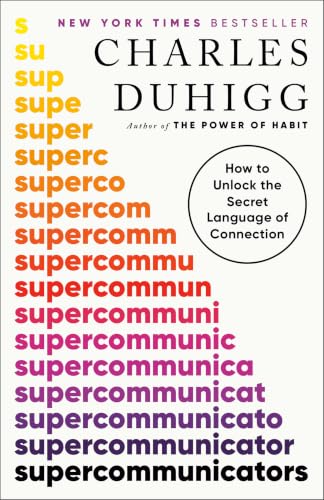
Supercommunicators
Charles Duhigg

The Power of Habit
Charles Duhigg


